Wednesday, January 23, 2013

Canyon Trip

Monday, 14 November, 2011

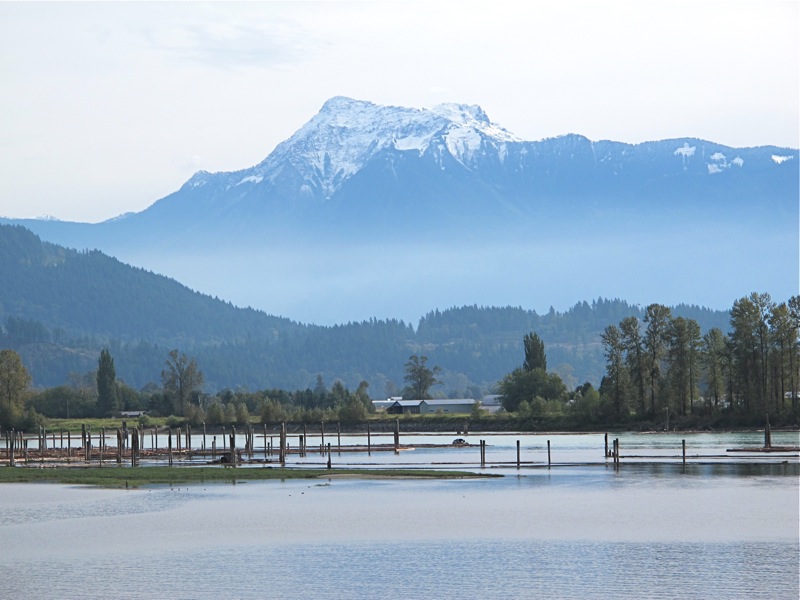
In mid-October the weather was so nice that we decided to take an overnight trip up the Fraser Canyon to Cache Creek and back through Logan Lake and the Nicola Valley. Here's a link to a map of our route  

We travelled along the north side of the river to Hope, continued north on Hwy 97 (yellow) to Cache Creek, and returned through Logan Lake (grey) to Merritt, then Hwy 5 (green) back to Hope.
Since the road hugs the Fraser River, the scenery is spectacular, both along the river ...


and through the rocky crags of the canyon. This is just one of several tunnels that the road runs through.

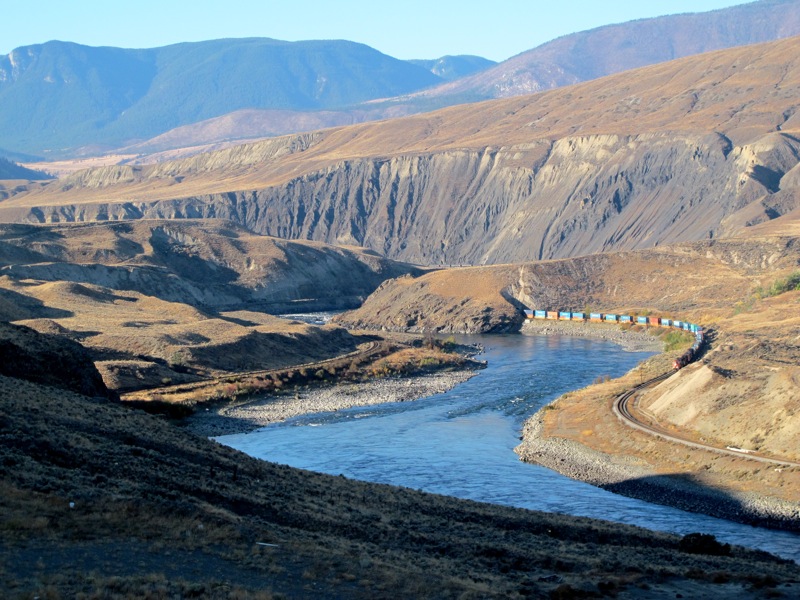
Trains run constantly along each side of the river. It used to be that the Canadian Pacific had its track on one side and Canadian Northern on the other. Nowadays they share the tracks and all eastbound trains run on one, all westbound on the other. No doubt it's both safer and more efficient.


I love how the blue of the containers in this last shot echoes the blue of the water.


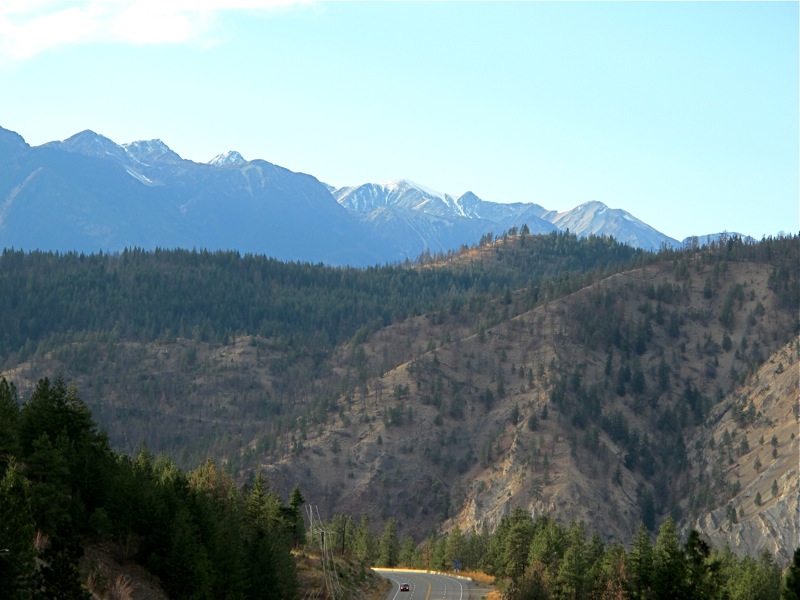
Looking up at the mountains is as impressive as looking down at the river.


Fall colours had started to infuse the landscape,


some requiring a close inspection.
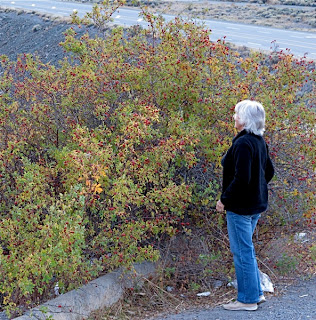

Surprise, surprise... it's a rose!


By sunset we were almost at our destination.


We had hoped to stay in Ashcroft, which is a pretty little place, but has suffered the fate of many small interior towns as people leave for lack of work. Cache Creek has more industry, including a dump for much of Vancouver's garbage, but is ugly. However, it does have motels.

The following day we began our way back through the Nicola Valley. This is a more settled, less rugged landscape than the Fraser Canyon. There are signs of abandonment here too, picturesque and a little sad.


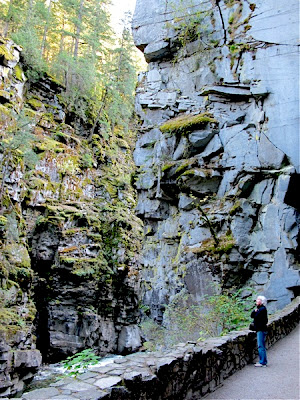
Halfway home we took a turn-off from the highway to visit the Quintette Tunnels. This little-known miracle of engineering provided a route for the Kettle Valley Railway from the Interior to the Coast. The architect of this feat had himself lowered in a basket into the chasm cut by the Coquihalla River in order to plot how the track could negotiate the river, which at this point winds back and forth through massive rocks. He achieved his goal by linking three tunnels and two bridges. The site is now a provincial park and the former railbed is a walking trail. It is one of my favourite places to take overseas visitors to absorb some of the wild beauty of this part of the world. The tunnels are quite dark and it's advisable to have a flashlight to negotiate through them, but the views from the bridges in between are awe-inspiring.


1 comment:

Sarah Jane said...
Somehow I missed this post earlier. Are the shots from the trip taken with the new camera? There are some wonderful ones. You definitely have an eye for landscape. My favs are the misty mountain that leads this post, the cottages and trees reflected in the lake and the blue railway cars and landscape. I also was really impressed by how colour of the carriages echos the lake. Fantastic shot!

Thursday, September 15, 2011

Chicago (continued)

Of course Chicago is all about tall buildings. I particularly liked views that juxtaposed buildings from different periods of the city's history.


On Thursday we took a river cruise offered by the Architecture Institute, which gave us the opportunity to see some of the more significant buildings from a good vantage point. It was a grey day, threatening rain. At one point a fierce squall of wind and rain combined sent us all scurrying below decks. At least one padded seat cover flew off into the river. Fortunately, it was short-lasting, perhaps ten minutes, and we were able to emerge again. The crew provided paper towels to dry off the seats, the tour guide remained cheerful and all was well although we probably missed a little of her usual commentary.


From the level of the river we were below grade, so that they looked even taller than from street level.


The gardener in me was just as intrigued by the mature ginkgo trees planted along the riverside in front of a "green" building.

Wednesday, July 27, 2011

Chicago (continued)

Carol, who gave me the tour of the botanical garden on my first day, works in downtown Chicago on the fortieth floor of a skscraper. We went there to meet her and to marvel at the view from her office windows.


Then she took us on a tour of some of her favourite interiors, which were truly amazing illustrations of the style and wealth of Chicago in its heyday.


Carol also took us through another area of park...


...where we admired the Victorian style bedding scheme, as well as a horse statue to which someone had added legwarmers.


We ended the tour at one of Carol's favourite installations, an array of giant legs...


where we rested our own for a while...

...before parting company with Carol and heading back to our hotel.

Chicago (continued)

Close to Millennium Park is the Art Institute of Chicago. Naturally we visited and spent the better part of a day there, including having lunch in their pleasant cafeteria, overlooking an inner courtyard.
Some of the world's best known art pieces are here, like Grant Wood's American Gothic, Edward Hopper's  Nighthawks and Seurat's A Sunday Afternoon on the Island of La Grande Jatte. There was also the best collection of Monet's haystack paintings we've seen, six of them on temporary loan from other institutions, all hung together so that you could see how the artist had interpreted the subject in different lights and at different times of the year. Apart from these and a few other canvases, however, we were slightly disappointed in the quality of the paintings; there were a lot of second-rate works by first-rate artists.

One object of interest to me was this clay chicken. I like its simplicity and the way the body was fashioned as a flat piece and then folded to give a realistic tail.


Another temporary exhibition was a series of baskets made by one of the last practitioners of this traditional style Japanese of basketry, an American who returned to his ancestral home to study the techniques. The baskets, all exquisite, ranged from large, powerful pieces...


...to small, delicate ones.


Even the room they were in was beautiful, specially designed to complement the display.

Friday, July 22, 2011

Chicago

The first time we headed downtown, we took the El, the elevated rail system. It's a slow train, stopping many times between Evanston and Chicago, but it's interesting for both people-watching and for views over the surrounding houses and yards.
We disembarked at one of the downtown stations. Since the El runs so frequently, every few minutes, there's never a crowd waiting for a train. It might be different in rush-hour, which we avoided.


On the way down to street level, a cute warning sign caught my eye. Unlike many railway diagrams, the message is clear enough without the text.


From underneath, the whole structure makes a great piece of sculpture...


 ...though I did wonder, as trains rattled over, whether we all got a dusting of rust in our hair.

 We had arrived at the Harold Washington Library, an imposing building of dark red brick and granite, which would look even more dramatic if the canopy over the stairs to the El station wasn't right in front of it.


The most extraordinary thing about the building was the metal sculptures on the roof. (The architectural word for them is acroteria, I have learned, and the corner ones are supposed to represent owls.)


From this point it was just a short walk to Millennium Park where the famous Cloud Gate sculpture (more popularly known as "The Bean") is the biggest attraction. 

Like everyone else, we had to photograph ourselves in its shiny surface with the Chicago skyline behind.


Just like the El, the best photo op was from right underneath. That's us, bottom centre.


The park also includes an open-air stage and adjoining bridges by Frank Gehry, who is best known for the design of the Guggenheim Museum in Bilbao. I didn't care for the stage much, but liked the sinuous curves of the bridges.


Best of all, from my point of view, was the adjoining garden designed by Piet Oudolf. His sweeping style really lends itself to a large site like this.


The view to the north has the Gehry amphitheatre looming in the background.


The garden is enclosed by dark evergreens and surrounded by a watercourse. On a hot day, it's a tempting place for a couple of young lovers to sit.


Across the street from the garden was a suitable plate-glass window for another mirror shot,although we appear only as silhouettes.


Also in the vicinity is the Cultural Center, which has a dome by Tiffany...


...and the dismantled and reassembled main room of the old Chicago stock exchange, too vast for my small camera to encompass in one shot. The room is all that was preserved when the building was torn down.


We returned to Evanston on the Metra, and used it for the rest of our stay when we wanted to go downtown. The terminus is in a large glass and steel skyscraper that people enter from the street and trains enter on an elevated line through a hole in one side. Inside, it's a vast, dark cavern with about 12 platforms lo-o-ong platforms. At some of them, huge locomotives wait for passengers to board or disembark.