Saturday, March 28, 2009

India: The Road to Jaipur


Our "deluxe" bus from Agra to Jaipur had the usual dents indicating its prowess in Indian traffic negotiations and an almighty crack in the front windshield. It was supposed to be air-conditioned. At some point, presumably when the air-conditioning failed, small fans had been attached above the side windows, but those didn't appear to be working either. Fortunately the windows could be opened and, although it was hot and sunny, the breeze remained relatively cool. The seats were much more comfortable than on our previous bus journey, a good thing for a 5-hour journey.

On arrival in Jaipur at dusk, we phoned our hotel and were told to wait for a driver with a card bearing my name and a secret password. On no account were we to go with anyone else. (No-one else approached us so there was no problem.) The tuktuk driver who arrived with the card hurtled out of the bus station right into the path of an oncoming bus, which caused Michael to wince, but apart from this initiation we had an uneventful ride to our hotel.

The candy-pink Pearl Palace, an amazing bargain at about $15 a night, is tucked into a dusty alley in the warren of streets surrounding the old city. It's a little way from the centre but transport is never a problem during our stay as there are always a few tuktuks and taxis outside, anticipating the steady flow of guests.


Our room, though small is nicely decorated: there's a frieze of red, green and gold flowers on the ceiling, a scalloped arch above the bed, and a bay with side windows overlooking the quiet courtyard of the adjoining building. High on both the outside and inside walls are a pair of small, semi-circular arches set with coloured glass in jellybean colours. there a mirror in an ornate wooden frame and two paintings of women in saris, one smoking a hookah. To hang our clothes there's a set of hooks; two inner ones which are simple knobs, two outer ones which are elephant heads, their trunks forming the hooks.

Tuesday, March 24, 2009

India:Fatehpur Sikri

There are few options for accommodation in Fatehpur Sikri, but we were lucky to choose the Goverdhan Tourist Complex, a well-run place separated from the busy main road by a stretch of lawn and garden. Our motel-style accommodation opened onto a terrace overlooking this courtyard, where we could relax in comfy chairs with some cool drinks.


In the distance, the minarets of the huge mosque, part of the palace complex we had come to see, rose above the town.


When we left our table briefly to explore, we returned to find a monkey, a large male mandrill, trying to drink Michael's beer. Michael swiped at it with his sketchbook and it wasn't at all intimidated, merely snarled and lunged at him. The owner hurried up to see what the commotion was about, shrugged his shoulders and said philosophically, "It is the way of the monkey."
Nevertheless, he sent an underling with a stout pole to drive it away.

The room itself, which the Lonely Planet guide snobbishly describes as "odd" in its decor, delighted us with its walls painted in bright sari colours of saffron, red and lilac. The restaurant served excellent food, all washed and cooked in filtered water. The owner and his cook/right-hand man were charming.

Mid-afternoon we climbed the small hill towards the imposing red-sandstone mosque. It sits on a high plinth with very steep steps leading up to the entrance.


We decided not to climb these and skirted around to the right up a more gentle incline towards the palace itself. Also of red sandstone, it was built by Akbar the Great, who occupied it for a scant 15 years before moving on: he had inadvertently chosen a site without access to water.

Forgotten for the intervening time, the palace is remarkably intact. There are several buildings separated by spacious courtyards...


...and elegant colonnades.


The Hawa Mahal (Palace of the Winds) has intricate screens carved from single slabs of stone, each one a different pattern. From behind these screens, the maharajah's wives and concubines could look down on the activities in the courtyard below without revealing themselves to the public gaze.


The whole complex effectively combined powerful massing with delicacy of detail and airy open spaces. It remains one of the highlights of our visit to India.

Akbar was a learned and curious man, tolerant of all religions. In his hall of audience he liked to engage in discussions with scholars and foreign visitors, who sat on the floor of the hall while Akbar himself sat on an ornately carved "pulpit" reached by bridges from the four corners of the room.


With few visitors, the palace had a contemplative, slightly melancholy air. By contrast the mosque, which we then approached through Akbar's Gate, a short, level walk from the palace, was a hive of activity. Leaving our shoes in the care of man at the gate, who already had quite a pile of them in his keeping, we entered the courtyard to find ourselves approached by hawkers of postcards and persistent would-be tour guides. It seemed somehow inappropriate that this place of worship should be such a marketplace. Pausing only to admire the carved marble screens (but not the electric light configuration) around the tomb of a local saint ...


...we beat a hasty retreat, regaining our shoes only by payment of a small fee.

When we returned to our room, we found our chairs on the terrace occupied by a couple of American boys who had arrived while we were sitting there earlier. Despite other chairs and tables being available, they had moved our clean laundry, which the maid had left on the chairs for us, in order to sit there. Taking our cue from the owner, we shrugged and told ourselves, "It is the way of the American."

The following morning we set off for the bus station, or rather, the dusty yard that served as such, to return to Agra. Although this was going to mean retracing our steps, it would allow us to get a "deluxe" bus for the 5-hour journey to Jaipur instead of continuing on a slower and less comfortable bone-rattler. Michael filled in the wait by sketching the Fatehpur Sikri market scene around us. I managed to get a couple of photos before he attracted the usual small crowd of curious passers-by.


India: On the road

Agra itself is not an attractive city and so, after returning to our hotel for breakfast on the terrace with the Taj Mahal looming in the distance, we headed for the local bus station...


...to board a bus for the one-hour ride to Fatehpur Sikri and its long-deserted palace, a sight well worth seeing according to Val and Sue, new friends from Melbourne that we met in Delhi.

The journey was typical of others we were to make: rattling old bus, bearing the scars of encounters with assorted other vehicles,


road cluttered with aforesaid vehicles,


not to mention pedestrians, occasional cows, sheep and goats.


Buses, by virtue of their size, appear to take precedence over other road users, and the drivers take full advantage of this, sometimes to the point of taking to the wrong side of the road and challenging oncoming vehicles face to face. On at least two occasions we came to a sudden halt inches from the front bumper of a smaller truck or van.

Nonetheless, we arrived unscathed in the heart of Fatehpur Sikri, a small but bustling town not yet on every tourist's list of destinations.

Monday, March 23, 2009

India: The Taj Mahal

Of course, you can't go to India and not see the Taj Mahal, Shah Jahan's monument to his beloved wife Mumtaz who died giving birth to their fourteenth child. As you would expect, security around the Taj is tight, so tight that even Michael's sketchbook and paints had to be left at the gate.
The marble tomb is so often photographed alone, that it was a surprise to enter through the huge red sandstone arch and see the two flanking buildings also of sandstone.


We arrived just after dawn and watched as the mists rising from the grounds and the river below enveloped the building in a mystical haze. Unfortunately, our photographs look no different from thousands of postcards and other images taken of this amazing place.

Sunday, March 22, 2009

India: Delhi to Agra

The trains of India are famous, so travelling at least once by train is an essential experience. We have chosen this method of transport to get from Delhi to Agra - and as it turns out, this is the only time we will take a train.

Fighting through the crowds of porters, hawkers, loiterers and other passengers to the ticket counter, obtaining a ticket and finding the right platform is an exhausting enterprise. There's a train at the platform when we get there, surely not ours, as there appear to be no second-class A/C carriages which is what we have booked. This one is entirely open carriages with barred window openings and wooden slat seats.

All signs are in Hindi and a couple of hikes up and down the long platform reveal no apparent railway official, but fortunately I eventually strike up a dialogue with an intelligent-looking woman in western clothes who speaks faultless English with a California accent and who assures us that, indeed, it's not our train, which will arrive after this one departs.

(Lin turns out to be a delightful acquaintance: a Major in the Indian army, she is returning to her unit based in Agra. As of this moment she is preparing with 5 colleagues to climb the fifth-highest peak in the Himalayas as part of an army promotional exercise.)

While we wait, other passengers come and go or settle to wait on our platform, and trains pass by on adjoining tracks.


Minutes before our train is due to arrive, the one occupying our platform pulls slowly away. Ours chugs in, but we are still trying to find our carriage when, without any warning such as a flag being waved or a whistle blown, it begins to move. Following Lin's lead, we run for the nearest door and leap in. Michael, who is last, barely manages to haul himself aboard as the engine gathers speed.

It is already evening and very soon dark, which is just as well since we can make out little through the double-glazed and amber-tinted windows. During the 4-hour journey we are entertained by men passing regularly through the carriage carrying large canisters of tea, sold by the plastic cup.

It's ten o'clock by the time we reach Agra. Fortunately, at our request, our hotel has sent an auto-rickshaw to pick us up, as we have no idea of the layout of the city. The hotel is not very prepossessing and our room, though clean, is cell-like with a barred window opening onto a light well. However, the great advantage of this particular hotel is the view of the Taj Mahal from its roof terrace, which compensates for its other deficiencies. Michael happily spent time up at this vantage point with his sketchbook, and the results can be seen on his website.


As we arrive, we encounter an unexpected bonus: in the street below, under a light-strung canopy, a wedding celebration is winding up.


In the morning, the revellers are gone, and the area is deserted except for a cow picking through the remains, and couple of parked auto-rickshaws.

Saturday, March 21, 2009

India: Delhi

India is an assault on the senses.
The colors are exhilarating.
The smells vary from enticing to repellent.
The tastes are tantalizing although sometimes so hot that you don't taste anything but the heat.
Touch can be sensuous as when you run the finest Kashmiri cashmere through your fingers, or cringe-inducing as you recoil from the clutching hands of beggars, or just shoulder your way through sidewalk crowds.
Sound is constant and deafening, whether it's the blaring of horns in traffic, the electronically delivered and amplified call of the muezzin five times a day, or the radios churning out their daily quota of Bollywood pop songs.
In Delhi, you live twenty-four hours a day with this plethora of sensations and you learn to adjust.
Photographs inevitably fail to capture the onslaught of bodies, vehicles, noises, dust, heat and pungent aromas. The best we could manage were shots of the Sunday book market in Old Delhi, with booksellers crowding the pavement with their wares, forcing pedestrians into the nightmare traffic of auto-rickshaws, bikes, motorbikes, cars, buses, camel and donkey carts.
Interestingly, the Indian owners of the upscale and serene pension where we were staying were awed by our venturing to this market; they had never gone there themselves.
That's me, bottom right in the hat, in the third picture. (I didn't actually buy, but Michael purchased a paperback novel by Peter Ustinov. Who knew he wrote a novel? It's called The Loser and is a story about a German SS officer who does everything wrong and is eventually brought to justice, whereat he commits suicide. Odd.)


One of the things we noticed in India, and that is evident in these pictures, was the immaculate dress of the average Indian. Apart from the beggars, who have perhaps a motive for looking unkempt, most people on the streets put us shabbily-dressed tourists to shame. The men were all in crisply ironed shirts and long pants, the women, with a few young jeans-and T-shirt-clad exceptions, in their vivid saris.

Our home-away-from-home while in Delhi was the Thikana, a lovely, well-decorated pension with a rooftop terrace, where we recovered somewhat from the jetlag with a cup of tea among the cushions.


As well as breakfast, they offered delicious evening meals, where we met other interesting travellers who, like us, had found this little haven on the web. Thikana is in a leafy suburb of south Delhi, and the meals were welcome as finding a restaurant at night meant venturing out some distance into the unceasing hubbub of Delhi streets. Delhi is not a walkable city, and is even less so at night when the poorer denizens of the city bed down on the sidewalks, obliging you to step into the traffic to go around them.

During the next couple of days we visited some, but not all, of the standard tourist attractions:

Lal Gila (Red Fort):


(In this last image, the men are hoeing up the lawn, presumably to renew it although to our eyes it looked perfectly fine.)

Chandni Chowk, the picturesque and crowded heart of Old Delhi:


India Gate, designed by Lutyens and a vestige of colonial rule:


Delhi Museum of Modern Art, housed in a splendid building, formerly the residential palace of the Maharaja of Jaipur, which should draw more visitors than it does:


We ate delicious food everywhere, but best of all was the take-out chicken tikka roll from Khan Cha Cha at the Khan market - so good we went back for more on the following day.


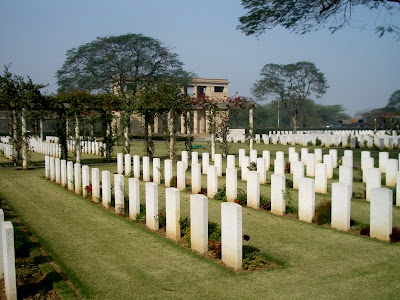
The most moving experience of our time in Delhi was our visit to the Delhi War Cemetery, where my father, who died on the Burma border in a RAAF plane crash when I was a baby, is buried. In sixty years, I am the first member of my family to visit his grave. The cemetery is beautifully maintained, and is a serene and silent oasis in noisy, bustling Delhi. There were no other visitors on the morning of our visit. A worker mowing the grass between the graves stopped respectfully and waited until we were departing before he re-started his machine.