Tuesday, December 19, 2017

INDONESIA -Jakarta

October 8 -11, 2017

We arrived in Jakarta at midnight on October 7th and spent the night in a hotel close to the airport. The following morning we took a taxi into the heart of the city to stay several days with friends, Helen and Ken, who have lived in Jakarta for 27 years. Their attractive house is set in a tropical garden and has an inviting pool for escaping the heat and humidity


Greater Jakarta has a population of 30 million, resulting in tremendous traffic jams. Almost everyone owns a motorbike as this provides more mobility than a car and it's common to see families of four on one bike with the kids standing between the driver's legs or clinging on between mom and dad. Many passengers use one of the three motorbike-share companies operating in the city - Gojek, Grab and Uber - to ferry them to their destination. Judging by the brand on the helmets that both driver and passenger wear, Gojek, the local company, is the most popular


There are few sidewalks and those that exist are generally occupied by parked motorbikes so walking is not an option. Public transport is a mystery to all but locals. Ken and Helen, like most expatriates, have a car and driver.

On our second day, Ken took us to the hill city of Bogor, 60 km south of Jakarta, to see the Kebun Raya, Bogor's world-renowned botanical garden.


 From the terrace of the pavilion in the background above, there's a long view down towards the entrance.


Most visitors to the garden seemed to be locals, and this groomed part of the park was a clearly popular venue for weddings.


However, a short stroll from the manicured lawns and gardens leads you into a landscape of fantastic Tolkien-like trees and giant lily pads.


Many of the trees had exposed roots.


Unfortunately, few of these magnificent specimens were labeled
Kapok trees that were labelled reminded us of childhood pillows for which kapok was a common stuffing.


Tufts of the silky substance had fallen among the roots.


Attracted by a platform built around one palm, we went up for a closer look...


... and found it was a Coco de Mer (Lodoicea). A sign explained the reason for the platform.


Having a 30 Kg seedpod drop on your head would probably be fatal! Other trees in the vicinity had dangers too.


Before we left, we peered through the gates of Buitenzorg palace, now occupied by the current President, but once a retreat from the heat and humidity of Jakarta for the Dutch Governors of the former colony.


From 1812 to 1816, when the British took control of Batavia, Stamford Raffles lived there. His wife died there and is buried in the botanical garden that he is credited with initiating.


**********
The following day we drove to Sunda Kelapa, the historic port serving the city which has since grown up around it. First stop was the docks where pinisi, the traditional wooden boats, still load cargo for Indonesia's 3,000 islands. Originally two-masted sailing vessels, they have mostly become motorized in the last 40 years.


A New York Times article describes them this way:

"For more than 100 years starting with the middle of the 19th century, these boats, designed and built by the Bugis, a seafaring people originating from the island of Sulawesi, were used to carry cargoes between Indonesia’s 17,000 islands. Following the seasonal monsoon wind patterns they would sail westward for six months before turning back to retrace their passage eastward over the rest of the year."

In former times the Bugis also had a reputation for fierceness and piracy. Our word "bogeyman" originates with them.

From the docks, we made our way to Taman Fatahillah Square, also known as Old Batavia where we had lunch in a lovely restaurant overlooking the colonial-era buildings that ringed the plaza.


In its heyday the restaurant catered to a high-society, gay crowd as the women's washroom decor still reflects.


After lunch we set off back to Jakarta, a journey that took us five hours, thanks to the biggest traffic jam we've ever experienced. Luckily for us, Ken is a wonderful companion and kept us entertained with anecdotes, information and general good conversation.

Tuesday, March 7, 2017

ECUADOR - Otavalo (January 28 -30,2017)

On Saturday morning we took a bus from Quito to the town of Otavalo, a two-hour journey. Otavalo is famous for its handicraft market and Saturday is the day when the most vendors set up their stalls.
Buses in Ecuador are as brightly-coloured as the shawls we were about to see in the market.


The journey took us through countryside that was not as spectacular as we'd seen in Peru, but nevertheless dramatic: bare mountainsides cut by deep ravines.


We had booked a hotel on the hillside just above town, giving us an overview of the locale, and a glimpse of the cloud-wreathed volcano across the valley.


From there it was a steep but short walk down into the commercial centre. On the way, I spotted an unusual "welcome sign" on a wall we were passing.


 The market occupied all of the main square. I took this photo from a bar where you could enjoy a mojito while you watched the action.


There were all kinds of alpaca sweaters, bags and hats,


... necklaces


... embroidered blouses


... and, the most colourful of all, gorgeous woven shawls.


If I'd had an extra suitcase, I'd have filled it with these.
By comparison with their wares, most of the vendors were soberly dressed in black and white.


We spent much of the afternoon just wandering around, enjoying the scenery, but as we sauntered back towards our hotel we encountered a parade that appeared to be celebrating either the winning of a trophy or the start of a game to decide the winner. 


The following day, we boarded a bus to Ibarra, the regional capital an hour further north, to see the colonial architecture that has caused it to be known as "the white city." 


Not all of the buildings were white; some were natural brick, both old ...
 

...and new.

Most of the shops were shut and the town seemed deserted on this hot Sunday afternoon, but we found a cafe serving icecream and took our cones to a shady seat in the pretty central park with its neat parterres and flowering trees.


Monday was our last day in Ecuador, but as our plane didn't leave until midnight we had most of another day to enjoy Otavalo. We had hoped to visit a nearby condor refuge but discovered it was closed. Instead we took a taxi to Peguche waterfall, not far from the town. A taxi dropped us in a small cluster of shops at the start of a short trail where the main item on sale seemed to be mosquito repellent of various kinds. Fortunately, we didn't encounter more than one or two during our visit.
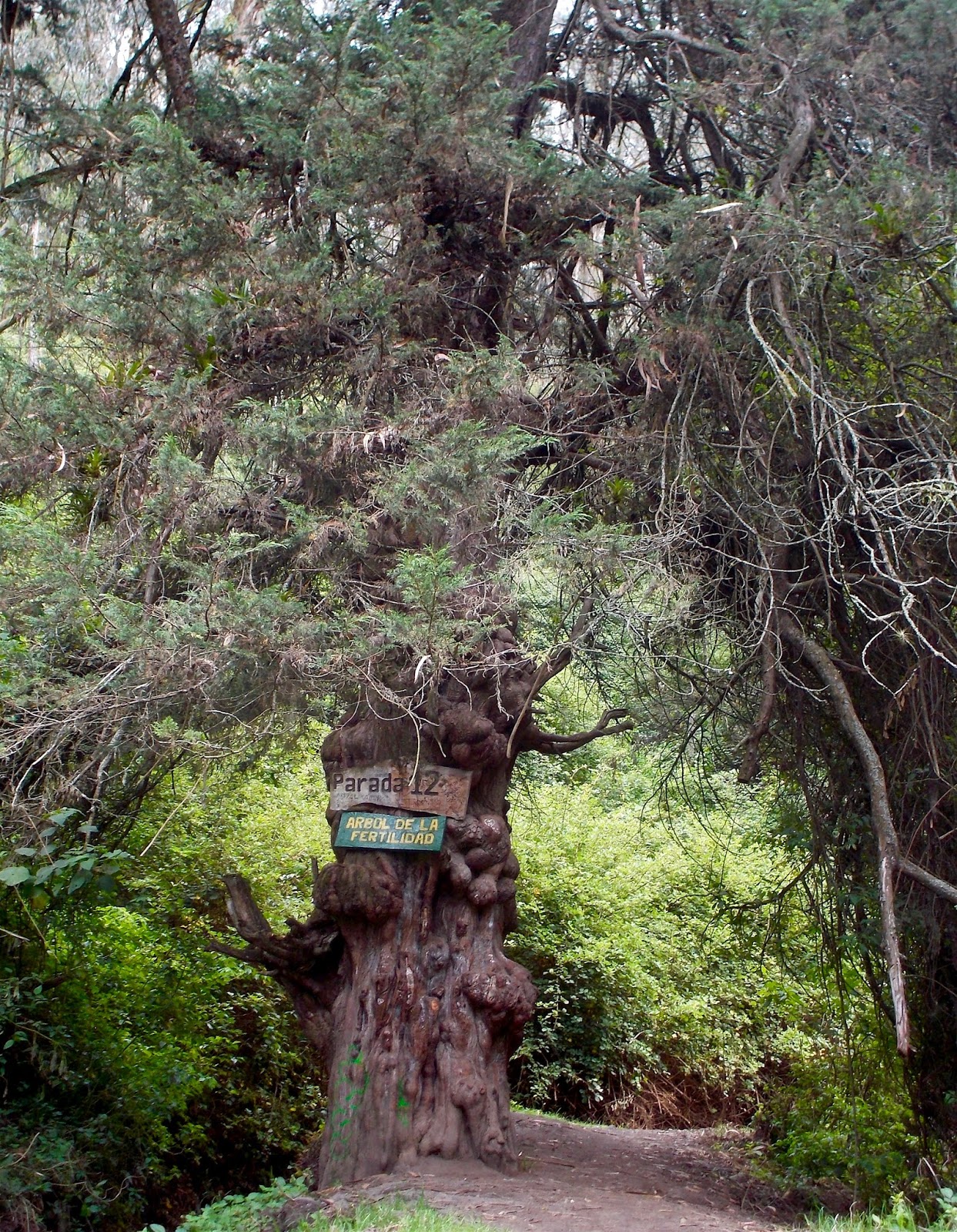
Along the trail we came across an ancient tree that obviously had some local significance. The sign identifies it as Arbor de la Fertilidad, Fertility Tree


There had been some significant rain and the waterfall was impressive.


A number of local people had come to see it too, including a group of youths who were clambering over the rocks at its base. One of them slipped and managed to soak himself completely in the chilly water.


We decided to walk back to town, which gave me a chance to see close-up a plant I'd noticed growing wild in numerous places along to road all the way from Quito. Lion's ear (Leonotis leonurus) is an annual or occasionally a short-lived perennial in Vancouver, and it was interesting to see it growing so freely that I assumed it must be native to South America. However, it's South African.


Back in Otavalo, we sat for a while in a coffee shop on the edge of the market as a sudden rainstorm descended on the town. Across the road a street musician had taken shelter under a convenient stall awning and whiled away the time serenading the owner.  He moved on when the awning suddenly tipped a deluge of water onto them both.


 When the rain stopped, we spent some time exploring parts of the town we hadn't seen before. In an area around the government offices, we noticed some lovely stained glass work attached to the lamp posts. We even went back later to see how they looked at night, but the lamps were too dim to illuminate them as well as the evening sun had done.


After that it was time to catch our bus back to Quito and the airport. Through the tinted window I took a last shot of another of the several volcanoes ringing the valley.