Tuesday, November 17, 2009

Melbourne to Daylesford


November 15


Brunch with the cousins and a visit to a craft market in the morning. A couple of buskers were making merry at the entrance to the hall where the market was held.


While we waited for the others who were still shopping inside, I tried rather unsuccessfully to capture an image of Ray, Michael and me in a convenient shop window. Michael has honed these mirror image shots to a fine art, but I'm still learning not to hold the camera in front of my face.


We said farewell to the cousins and chugged off north towards pretty rolling countryside.
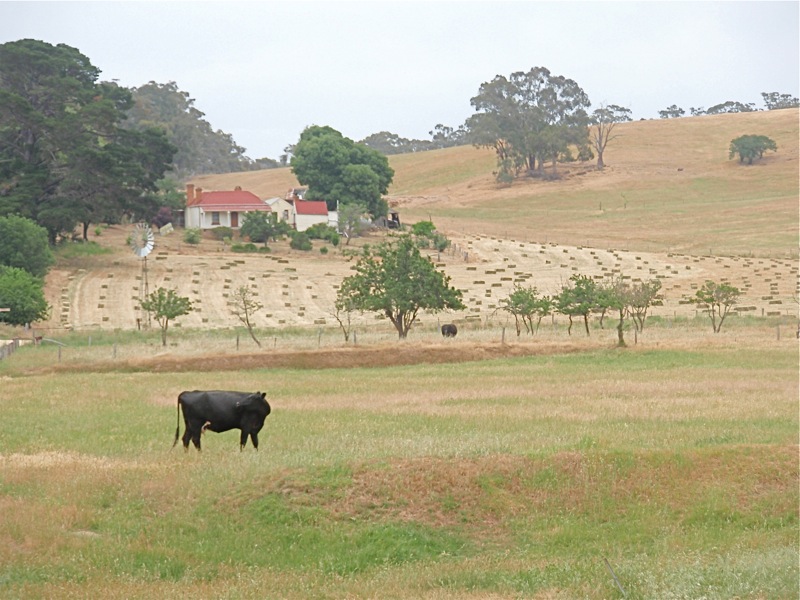


The signs welcomed us to "spa country" and the towns were full of upscale cafes, bed-and-breakfast cottages, and of course spas offering all sorts of luxury, much of it lost on me as I've never enjoyed sitting in a bath, regardless of whether it is filled with rose petals, dead sea salt, essence of ylang-ylang, melted chocolate (ugh), or just plain water.


Daylesford, where we stopped for the night, is one such town. Caravanners are obviously not the clientele they are angling for: the luxury did not stretch to the two caravan parks which were both rather scruffy.

Aireys Inlet to Melbourne

November 14

As always, we were woken by the birds. Sometimes it's been the squawking of cockatoos and lorikeets, sometimes the cheeping of honeyeaters and wrens. This morning it was the carolling of magpies and an occasional cockatoo. When I looked outside, I saw a cockatoo and a magpie squaring off over some birdseed someone had scattered. The cockatoo won the day with much flapping of wings and fanning of his yellow crest. Unfortunately I could not get my camera out in time to catch this display, and only captured the victor tucking in, while the disgruntled magpie sloped off in search of other spoils.


We drove up the hill to admire Aireys Inlet's fine old lighthouse, before setting off for Melbourne.


From the lighthouse, we had a final view of one more lovely rocky islet.


We stopped for lunch at Torquay which bills itself as "Australia's finest surf beach." Oh really? It certainly didn't look it on this particular day, unless the number of hopeful boardriders was what counted.


There were certainly lots of them but not much in the way of waves at all.

After that it was full speed ahead for Melbourne and my cousin Chris's 50th birthday party. This was a great way to wrap up the day with much drinking of champagne and general wellbeing. Afterwards, we went on to a North Melbourne eatery with some of my cousins, ending up at cousin Cathy's townhouse, just around the corner, for the night

Port Campbell to Airey's Inlet


November 13


The Port Campbell caravan park was full of tourists like ourselves, traversing the Great Ocean Road. It is the closest town to the Twelve Apostles, a set of limestone pillars surrounded by the sea. In recent years, a couple of these have collapsed, undermined by the constant waves, but according to the information I read, a few more have been carved off from the mainland as well. There are apparently 13 apostles at present, although not all are visible from the coastal viewpoints.


There were lots of happy tourists taking photos of each other, and one kind soul offered to take one of us.


The natural heath on the clifftops, although not as spectacular as the turquoise sea and the offshore rocks, has its own beauty, with many silver-leafed shrubs among the green.


Leucophylla brownii is particularly attractive.


Several of the rocky islets are breeding grounds for mutton birds, or shearwaters, which come all the way from the Aleutian Islands off Alaska to breed and raise their young. They spend the days at sea, returning to their nesting burrows at dusk so unfortunately we didn't see any.


The parents leave for the north before their chicks are completely fledged; hunger eventually drives these young ones to take to the air, and somehow they find their way along the air currents in the wake of their parents. Only 50 percent of them make it as far as Alaska.

The road jogs briefly inland to cross the Otway ranges, becoming narrower and winding. As we descended towards the coast again, we admired the tenacity of farmers working these steep green hills.

This far along, the coastline flattens out and becomes less dramatic. Yet it merits a closer look as we discovered when we stopped to walk out onto a beach with an exposed reef where the tidepools were rich with sea life.


Shortly afterwards we arrived in Aireys Inlet, our destination for the night. It was Friday and throughout the early evening people kept arriving, presumably from Melbourne, to occupy the on-site cabins for the weekend. We were apprehensive that parties would go on all evening, but it was surprisingly quiet after dark. Everyone must have had a strenuous day at the coalface before the drive out of the city.

Monday, November 16, 2009

Port Fairy to Port Campbell

November 12

In the morning, when I went for a shower in what we caravanners call the "amenities block", I was startled by the sign that I passed en route.


Later I walked into the town, through the tiny botanic garden with its huge Norfolk pines.


The main street was busy with locals and tourists, but it was quiet along the river.


Just a few couples strolling, and one fishing boat crew organizing their lobster pots.


The heatwave was continuing in Adelaide and inland but on the coast it was tempered by a cool sea breeze. The air was a little hazy, but at least the fog stayed well offshore.

Not very far from Port Fairy is the large town of Warnambool, which has a very good art gallery. We spent an hour or so there, enjoying the exhibitions as well as the coolness. When we came out into the bright sunshine, the small park in front of the gallery was providing a convenient lunching spot for some of the locals.


Jogging briefly inland, we came to the remarkable Tower Hill which is, like Mt Gambier, the crater of an extinct volcano, and was a popular subject for early painters.


In fact, when the local authorities recently decided to restore native vegetation that had been stripped by farming, they relied on a painting by well-known artist Eugene Von Guerard for guidance in what had originally been there.


Back on the coast, we followed the Great Ocean Road, a tourist mecca as we found as we travelled along. Luckily, most of the traffic was coming the opposite way - from Melbourne - and we were not oppressed by impatient motorists, although there were quite a few coming towards us who were cutting the corners and having to correct very smartly as our beast lumbered into their path.

We made numerous stops along the route to see the remarkable landforms rising from the surging turquoise sea, encountering the same people throughout the day who were doing the same thing. The coastline here is so breathtakingly beautiful that it's hard to describe. Even photos, though they may be worth a thousand words, cannot replicate what the eye sees. The following are of the area called Bay of Islands:


We moved slowly along, stopping constantly to visit more viewpoints, and wound up in Port Campbell for the night.

Wednesday, November 11, 2009

Robe to Port Fairy

November 11

The morning news was full of reports on the heatwave and how to protect yourself by staying indoors, not exerting yourself, etc. But it was a cool, sunny morning in Robe and as we drove the short distance south to Beachport, we could see a bank of marine fog just offshore. Beachport was a charming little ex-whaling station with a long pier extending out into the mist.


There was ocean on one side, and funky old buildings on the other, with interesting fences,


and planters full of thriving succulents.


The scenery around the town was lovely.


The natural heathland was full of little flowers, including wild pelargoniums and asters.


From Beachport, the road turns inland, and we had planned to make a detour here into the Coonawarra wine region where Australia's most famous red wines, like Grange Hermitage, come from. But the temperature was predicted to reach the 40ºc mark there, so we gave it a miss and took a more direct route to Mt. Gambier, a large town, unique for Blue Lake, a lake in the crater of a long-extinct volcano. The water is grey all winter, but changes over a few days in November to a startling blue and remains that way all summer. Obviously the colour change was early in November this year.


Heading back towards the coast we drove through pine and eucalyptus plantations, and lush pastures where many happy sheep were grazing. In the late afternoon we came to Port Fairy, yet another delightful small port with a wealth of historical buildings. We found a campsite under huge Norfolk Island pines on the edge of the Moyne River, close beside this bridge.

Robe

November 10

We liked Robe, so rather than press on through another hot day, we decided to stay a second night. The small, picturesque town is pleasant to walk in, with large Norfolk Island pines along the shore and quaint old stone buildings housing most of the shops - a mixture of cafes, galleries and holiday cottages. It's difficult to get a good photo in these little streets, though, because they are so plugged with parked cars: the eye skims over them to the buildings, but the camera doesn't.

I spent the morning browsing while Michael caught up on some sketching. In the afternoon we took the path down through the dunes


to the beach for a swim,


winding up at this nice old stone pub for fish and chips in the evening.


Sunset along the shore in both directions ended the day very nicely.


Adelaide to Robe

November 9

The temperature was already 25º by 8:00 am. We bade a not too sad farewell to Sal and Mary, as we will rendezvous with them next weekend in Melbourne.
There was little of interest on the road until we reached Murray Bridge, so named because the first bridge to cross the Murray River (in 1897) was constructed here and is still in use.
We were glad to see that there was still some water in the Murray.


Then it was on down the coast past a couple of dried out ponds, now basins of pink salt, beautiful but no longer able to support the wildlife of the area.


The road runs beside the Coorong, a long thread of inland waterway which I remembered as a picturesque haven for waterbirds, especially pelicans, from my last visit in my twenties.


Sadly, drought and the granting of excessive irrigation licenses by various governments have turned it into a series of algae-infested, saline ponds, smelling strongly of dead fish. It was heartbreaking to see something so pristine and beautiful destroyed by greed and political ineptitude. Although we stopped at the pelican sanctuary, there were few birds to be seen there. I had to settle for photographing the sign!


The only sea creature we encountered was the giant lobster at the town of Kingston.


It was a relief to reach Robe, a small seaport further south on the brink of the southern ocean.


It has a caravan park right in town, with about half the sites overlooking the water. They had the best view and were consequently crowded in spite of having no shade from the baking sun.


One couple, in a wonderful homemade camper with its own solar power, had the best spot as they didn't need a hook-up to the electricity supply.


We chose an inland site, without a view but under a large tree, and had the area to ourselves.