Tuesday, February 4, 2014

George Town days

Thursday, October 31

We spent the morning checking out of Hotel 1926 and moving to Banana Boutique Hotel. In retrospect I preferred the former, even though it was difficult to get to and from on crowded buses. But the latter had the advantage of being right in the centre of town and it was an easy walk to most places of interest. It also had Helen, the most charming and helpful front desk clerk in existence. I'm surprised that there wasn't a line-up of local hotel management types trying to lure her away.

A major feature of the public space at Banana was its open atrium complete with fountain and pool of koi. When the afternoon rainstorms occurred, water poured into the pool from above causing the fish to thrash about in excitement.


Once we were settled again, we made our way around a couple of corners to a camera museum we had already noticed.
 A simple set of display cases held an amazing array of cameras from very early Brownies through to the present digital marvels. My favourite was an elegant 1930's Leica upholstered in snakeskin. There was a small room demonstrating how a pinhole camera worked and a tiny gift shop. We were the only vistors and were fortunate to have a very well-informed young man to show us around and point out some special features. Sadly, my photos of cameras did not work out (some kind of irony there), but I did get a nice shot of their mural.


When I googled the source of the quotation, I discovered that it is attributed to Ted Grant, described as Canada's "premier living photojournalist."
Emerging from the museum we found a posh little cafe nearby attached to a posh little hotel, and treated ourselves to a light lunch of tea and scones.


Refreshed, we made the short walk to Penang's art gallery only to find it was between exhibitions. One small room had some of the permanent collection on display, including a woodcut of chickens that appealed to me.


Another short walk brought us to Fort Cornwallis, the remnant of the old British star-shaped fort with its guns facing the Straits. The original prisoners' cells now contain a quite good history of the fort in quite bad English.
At a small stall in one corner, we bought popsicles. I played it safe with a mango one, but Michael bravely asked for durian, which he then regretted, describing the flavour as like eating a 3-day old unrefrigerated chicken. So much for the Asian delicacy!
We had hoped to catch the free shuttle bus back to our hotel, but after waiting ages, we gave up and trudged back on foot.
In the early evening we crossed the road and had drinks in the Hong Kong Bar, which we discovered was the favourite watering hole for Australian airmen attached to the Butterworth base on the mainland.


 It was not surprising then that the drinks were good. So was dinner, fried rice with chicken, at a street stall.

Friday, November 1

At breakfast we were able to observe some of our fellow guests, a rather seedy lot of expats, some with young Thai women in tow. We learned that they were in Penang on a "visa run" from Thailand, ie. their visas were running out and had to be renewed from outside the country. There is obviously a lucrative little business in shuttling them across the border in minivans, putting them up at various hotels while they apply for new papers, and then shuttling them back to Thailand. Fortunately, they were leaving later that morning.

Our event of the day was a visit to the Cheong Fat Tze heritage house, once the home of a wealthy Chinese merchant and two of his seven wives. After his death it fell into disrepair, but was bought and meticulously restored by a very determined couple. Now it's both a
museum and an upscale bed-and breakfast.


As the sign below says, Lonely Planet called it "one of the ten greatest mansions in the world."

The owners are justly proud of their restoration and we were lucky enough to have one of them conduct the tour we were given.


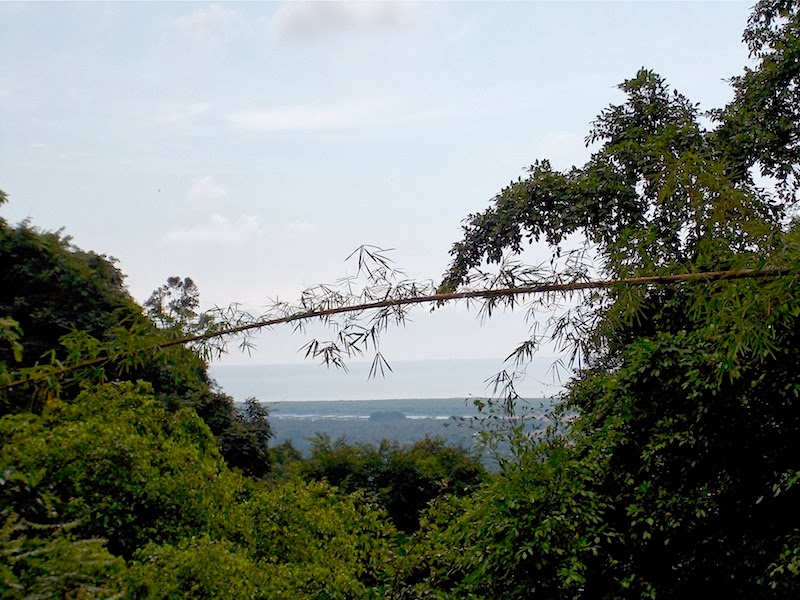
In the afternoon we rode the funicular up to the top of Penang Hill. It was a bit of a disappointment. The view from the top was spectacular, even though a bit cloudy,


 ...but the surroundings seemed somewhat rundown and neglected.There were a few stalls selling drinks and snacks, a have-your-photo-taken-with-a parrot-or-snake booth, and a small temple with this little piece of sculpture nearby. I liked the rat.


The return journey to our hotel took forever through very heavy traffic back to our hotel.Then the familiar lashings of rain began so that was it for the day.

Saturday, November 2

Without the visa-run guests the hotel was much quieter. After breakfast, we set out for the botanical gardens at the foot of Penang Hill. There we paid 2RM for a golf-cart ride that gave us our bearings for retracing the route on foot.

 Macaques were everywhere but seemed mostly well-fed and not too aggressive.


Among the interesting plants were a cannonball tree that was producing fruit and flowers at the same time,


...and several bat plants, with their trailing whiskers.


For the rest of the day we alternated between strolling the streets and retreating from the searing heat to the coolness of our room. Dinner at the Red Garden, a fabulous food court under canvas where dozens of food stalls offered Malay versions of cuisine from around the world.

Sunday, November 3

We went back to the National Park for a longer walk to a place called Monkey Beach. Shortly after we set out, the paved path became an unpaved trail. We persevered, scrambling over tree roots and through muddy patches, but when we eventually arrived at a sign saying we had 2 kilometres more to go, we turned back. We tried another paved path that promised a treetop walkway, but it too soon deteriorated and we were too hot and tired to continue. It might have been a better option in the dry season when the trails would be dry.


All the same, the scenery was worth the struggle.


That afternoon's rain was so torrential we had little choice but to stay indoors and get ready for our departure in the morning.

It gave me time to look over a few additional photos I'd taken during our stay that captured a little of the flavour of Penang.
These included the beautiful colonial Eastern and Oriental Hotel with its facade facing the sea


and with a lovely period washroom, which was the only room I could afford to occupy.


In the streets we saw a variety of vendors.


... and  some interesting murals, some of them installed by the city...


...and some of them not.


There were lots of lovely old Chinese shophouses,


...some of them meticulously restored,


...and some not.


And some where restoration was ongoing behind bamboo scaffolding like a work of art in itself.


So ended our last day in Penang.

Sunday, January 26, 2014

Circumnavigating Penang

Wednesday, October 30

The buffet breakfast at our hotel was extensive: rice dishes, toast, french toast with ample syrup, scrambled eggs, sausages and other meats, potato cakes. Thus we were well fortified for the day.
Michael had had the brainwave of renting a car for the day to tour the island, easily accomplished through a convenient desk in the lobby. Fairly promptly we were able to set off northwest through rows and rows of highrise apartments towards Batu Ferringhi (aka Foreigners' Beach.) We were amused by the warning on the dashboard of our car, especially #3, referring to the unbelievably bad-smelling fruit that is so popular in Southeast Asia.


Traffic near the downtown core was busy with cars juggling for position and motorbikes zipping into every gap often from the nearside of the cars. In spite of the melee, the give-and-take was remarkable, as was the fine judgement on how close vehicles could come to each other without touching. There was no road rage, no honking, no fist-shaking, just a good-natured tolerance of individual pushing and shoving.
As we left Georgetown behind, the traffic thinned considerably and we soon arrived at Batu Ferringhi, a pleasant but narrow stretch of white sand. No headlands, no curve, just a straight line between forested hills. This area was ravaged by the tsunami of a few years back and seemed not to have recovered its former popularity. The beach was almost deserted, cafes closed up, forlorn hotels lining the beach.


We took a stroll along the beach before making our way back to the car, passing a small dwelling clearly occupied by the local doomsayer.


The next town we came to, Teluk Bahang, was modest but more lively, relying on a resident population rather than tourists. The highlight for us was a small batik factory on the outskirts, where we were greeted by a nice young woman who gave us a tour of the operation. We seemed to be the only visitors and so were able to enjoy it at our own pace.
The factory produced both block-printed fabric,


and handpainted cloth.


The most delicate work was done with small brushes dipped in melted wax.


In spite of a shade cloth over the open-air workroom, it was incredibly hot and I admired the stamina of the artists who seemed not to notice the temperature at all.
Resuming our drive we passed the Tropical Spice Gardens, which looked too much like a theme park for us, and arrived at Penang National Park at the northwest corner of the island. There is no charge for the park, but visitors are required to sign in and out at separate booths for locals and foreigners.
We walked for some distance along the main trail beside the water which gave lovely vistas over sand, rocks and tropical blue seas.


At one point a large iguana crossed our path, lumbering up from the beach into the shade.


In spite of the views, the extreme humidity of the jungle we were walking through made it uncomfortable enough that we retraced our steps earlier than we had planned to the air-conditioned relief of the car.
The road now turned from the coast and climbed higher into the hills giving occasional distant views over the sea to the west.


We passed roadside stalls selling jackfruit and durians and stopped near a group of these at Titi Krawan where a trail runs alongside rushing cascades of water.


Some 40 years ago I had followed this trail to the waterfall where it ended. The path was much less groomed then and the waterfall deserted enough that we were able to have a quick skinny-dip in the pool at its base. This time, although the trail was still unmarked, it had been paved and groomed. Although we met no-one on it, when we arrived at the pool it was occupied by a crowd of noisy young guys, and we realised we had passed their motorbikes back at the roadside.

Our route continued down to the southwest corner of the island and into the small fishing village of Pulau Betang, where picturesque boats were moored along the sides of a lazy brown river.


Although the boats were made of fibreglass, their design still followed the traditional style of the old wooden boats with a long, pointed bow and raked profile. Red, black and blue flags hung from their sterns.
Assorted iguanas were swimming sluggishly through the water and large mudskippers occupied mudflats at the river's edge.


We had to retrace our steps back to the main road, which gave us the opportunity to admire some of the traditional wooden houses on stilts with an enclosed lower floor serving as garage and storage, and an upper storey with window shutters and decorative carving on the balconies.


After passing the airport at the southern end of the island, the road became a busy 6-lane highway . We almost missed the turn-off to our next destination, the Snake Temple.


This shrine is infested with deadly pit vipers curled over bamboo frames around an altar, with more of them in trees in the courtyard.


Local legend says that the snakes simply appeared one day, and moved in. Burning incense supposedly keeps them docile, although there were warnings about getting too cosy with them.


The surrounding courtyard was filled with greenery,


including a selection of bonsai,


and some exotic tropical flowers.


Back on the road to Georgetown, we encountered more heavy traffic, but as it thinned we could see ahead of us on a hillside a huge set of columns with a golden crown of distinctly Chinese roofs. This was the famous Kek Lok See temple containing an enormous statue of the goddess Kuan Yin. Although it was getting late and dusk was falling, we drove up to the top of the complex and found our way in, in spite of a notice saying it closed at 5:30. (It was already past 6.) There was no-one else there and so we had a chance to marvel at this extraordinary sight.


Unfortunately, with nothing nearby for contrast, these photos don't show the huge scale of the goddess.
On the edge of the surrounding plaza that overlooked the city far below were some impressive pieces of bonsai.


On our way out I took a photo of the elegant roof structure ornamented with little dragons and what looked to be a human figure riding a chicken.


It was almost dark by the time we left the temple and we were glad to get back to our hotel to relax and have a cooling shower. Too tired to go back to the centre of town, we walked a few blocks to a Thai restaurant for dinner. Its name, Chok Dee, reminded us of one of our favourite restaurants in Australia, and the food was just as good.

Wednesday, January 8, 2014

Back to the Coast

Tuesday, October 29

We rose at dawn to catch the 8 o'clock coach to Butterworth on the west coast. Although it was outside of normal breakfast hours, the innkeeper kindly made us some toast and instant coffee. The bus was not as luxurious as our previous one, but it was comfortable enough and there were so few passengers that we could each take a window seat. We took a different route on this outbound journey, winding down forested roads with fewer signs of habitation.


Sometimes a whole valley would be covered with shadecloth and greenhouses sheltering vast quantities of vegetables.


Once we left the highlands, the roadsides soon became a clutter of shabby houses, midrise apartments and an occasional monstrous highrise.


 From time to time we passed a rice paddy, palm oil or pineapple plantation or a commercial strip.


Strange outcroppings began to appear, reminiscent of the lumpy scenery in Chinese paintings.


It was midday and stinking hot when we disembarked at the Butterworth terminus and made the short trek to the adjoining jetty. We were just in time for a sailing and enjoyed the sea breezes flowing through the open decks during the 10-minute journey, as well as the views of watercraft and the muddle of old and new that was George Town, Penang's capital city.

Leaving Butterworth
En route to Weld Quay
The pretty side of Georgetown Harbour
Once ashore we had some difficulty finding the right bus that would take us past our hotel. This involved some risky running across the four-lane road and back because we weren't sure where the right stop was.

When that was sorted out we travelled along Chulia Street which, in spite of being the main thoroughfare, was narrow and crowded with parked cars wherever there was a gap between roadside stalls and motorbikes.


Malaysia seems to have embraced the concept of green walls. I noticed another on one of the few modern buildings.


Gradually the bus became more crowded and stifling, and we were glad to finally arrive at our hotel and find our room, which was clean and spacious and had tall doors opening onto a small terrace with a view of the swimming pool.